- Key Takeaways
- Evolution of Marble Quarrying
- Primary Marble Quarrying Steps
- Global Sourcing Regions
- Extraction Techniques and Machinery
- Modern Environmental Safeguards
- The True Cost of Stone
- Conclusion
- Frequently Asked Questions
- What is the typical process for quarrying marble?
- How is marble extraction different from other stone mining?
- Which countries are the largest marble suppliers?
- What machinery is commonly used in modern marble quarries?
- What environmental protections reduce marble quarrying impacts?
- How does quarrying affect the true cost of marble?
- Can recycled or engineered stone replace quarried marble?
Key Takeaways
- It soon progressed from hand-tool extraction to mechanized quarrying with diamond wire saws, chain saws and hydraulic equipment, increasing safety and production and reducing waste.
- The quarrying process follows clear stages: geological survey, overburden removal, face cutting, bench splitting, and block transport. Each stage requires specific equipment and skilled planning to protect block quality.
- Various quarrying methods are suited to differing circumstances. Diamond wire saws deliver surgical precision for hard marbles. Chain saws facilitate efficient straight cuts through softer beds. Hydro-bags provide low-impact splits of large blocks.
- Key producing regions include Italy, Turkey, India, Spain, and China, each with its own marble types and colors. Knowledge of regional characteristics assists in aligning stone to uses and market preferences.
- Contemporary marble quarrying must incorporate environmental protections such as slurry filtration, water recycling, and habitat restoration. It must also consider the reuse of marble waste to reduce lifecycle environmental footprint.
- To evaluate real cost, factor in life cycle costs such as extraction, processing, transportation, installation, and environmental or labor costs. Weigh these against alternatives when making buying or sourcing decisions.
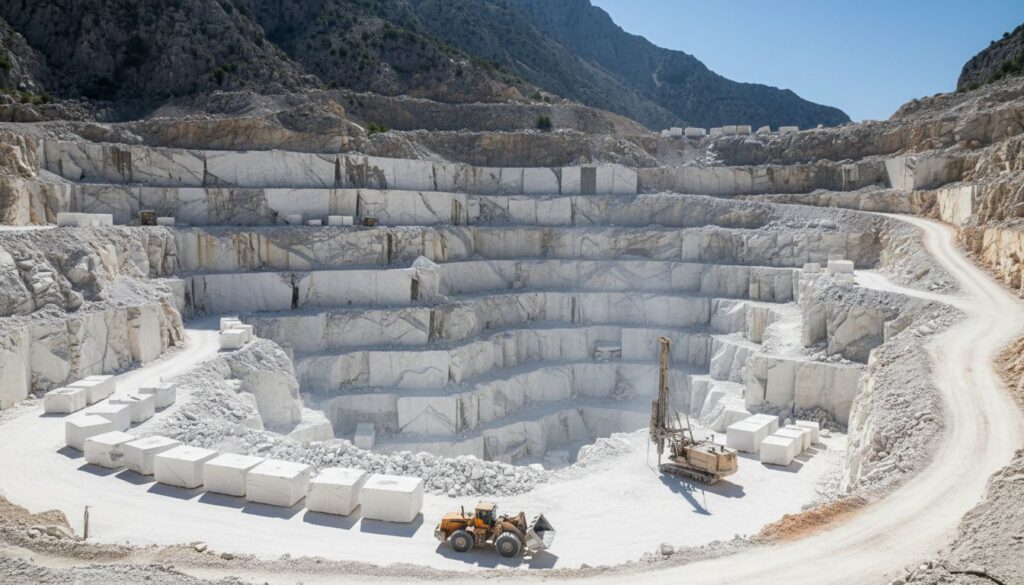
Marble quarrying is the process of extracting marble from the earth for use in construction and sculpture. It entails slicing big blocks from bedrock, hauling them away, and then eventually slicing and dicing them into slabs or tiles.
Contemporary quarries utilize wire saws, diamond tools, and careful blasting to increase accuracy and minimize waste. Environmental management and worker safety are key concerns in the industry, discussed below.
Evolution of Marble Quarrying
Marble quarrying has gone from local hand scale to a mechanized global industry. The transformation corresponds to changes in tools, transport, market, and ecology. They summarize the major developments, highlighting what changed, why it was significant, and where it led.
Ancient Extraction Methods
Primitive quarrying detached blocks with hand tools, iron chisels, wooden wedges, hammers and rudimentary channeling. Artisans followed veins by eye and used stone tapping to locate resonant slabs. The first organized techniques date back more than 2,000 years, noting Paros and Naxos in the 3rd century BC.
They dealt with flaws and cracks by selective cutting and by splitting around weak zones to avoid generating waste. When flaws developed, they sliced smaller blocks or utilized the shards for rough work. This method constrained block size and depended on expert estimation to prevent fracturing.
Main uses of quarried marble in antiquity:
- Temple and public building facings
- Sculptural works and statues
- Pavements and decorative inlays
- Funerary monuments and stelae
It was limited to producing small, irregular-sized blocks with rough surface finishes and significant material waste. Tool marks often remained and polishing was time consuming. Even in long-used sites, landscape change was still significant. Think Carrara, where hundreds of years of extraction reshaped local terrain.
Industrial Innovations
The Industrial Revolution brought steam power and mechanized drills, transforming quarrying from hand labor to powered equipment and greater production. Subsequently, explosives enabled quick blasting away of overburden and big blocks of rock with additional waste unless cautiously applied.
Diamond wire saws, introduced to Carrara in the 1970s, employ steel cables with diamond-coated segments to cut marble accurately and with minimal breakage. Hydraulic cranes and diamond-tipped drills make controlled, larger block extraction possible. Mechanization enabled quarries to churn out standardized blocks for architectural panels or industrial slabs.
Mechanization increased block size and uniformity and lifted material yield to approximately 75 to 80 percent for contemporary operations, versus approximately 20 percent for traditional ones. Water recycling systems minimize fresh water consumption while numerous quarries maintain reforestation programs and repurpose waste as tiles, powders, or engineered stone.
Comparative table of machinery:
- Traditional: hand chisels, wooden wedges, hand saws
- Modern tools include diamond wire saws, hydraulic excavators, wheel loaders, and block lifters.
Railroads and modern transport expanded the market by reducing shipment costs and allowed for export at scale. Increasing worldwide demand for marble in construction and design spurred investment in technology, which continued to enhance safety and minimize onsite manual danger.
Primary Marble Quarrying Steps
Primary steps of marble quarrying Each phase impacts block condition, loss and hazards. Expert crews and rigorous scheduling minimize waste and preserve value.
1. Geological Survey
Geologists survey deposits for color, grain, strength, and chemical composition to suit market demands and finishes. Core drilling and sampling provide information on bed thickness, uniformity, and defects, with cores aiding in determining an approximate volume that can be recovered and forecasting cutting characteristics.
Faults, joints, and bedding planes are logged to determine block orientations and sizes. A misread fault can generate scrap pieces. Based on detailed geological maps and reports, planning determines pit layout, extraction sequence, and whether to invest in a mill or export.
Ancient quarrying methods such as the panel cuts used by master craftsmen more than 2,000 years ago continue to guide today’s inspection of bedding and vein patterns.
2. Overburden Removal
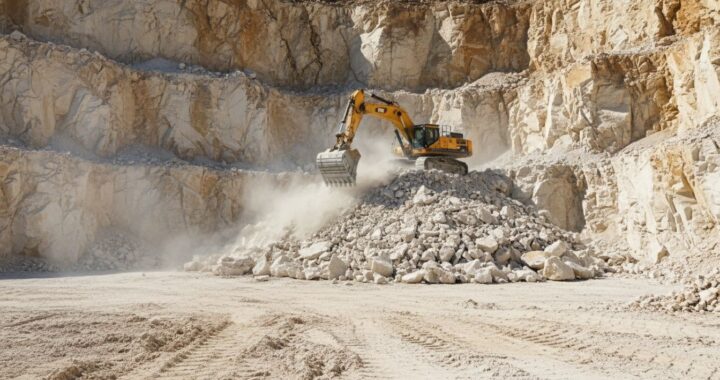
Crews remove soil, sand, and loose rock that lies above the marble bed with excavators and bulldozers. Its thickness is measured and logged for reclamation. Overburden is stockpiled, where achievable, for habitat restoration or landscaping, minimizing waste and reclamation expenses.
Dust control, runoff, and slope checks are continuous during removal to protect downstream water and slope stability. Documenting the overburden composition helps you plan backfill and site rehabilitation down the road.
3. Face Cutting
Diamond wire saws, chain saws, and channelers cut vertical and horizontal channels in the exposed face to delineate blocks. Primary cutting decisions are based on hardness, color uniformity, and visible flaws or fossils.
With Carrara marble, diamond wire cutting took off in the 1970s and currently produces far less waste than blasting. Precision matters: modern diamond wire systems can reach about 98% extraction precision and raise material use to 75 to 80 percent, compared to 20 percent with old blasting.
Quarrying teams measure cutting rates, tool wear, and energy consumption to optimize parameters and plan servicing.
4. Bench Splitting
Wedges, hydro-bags, or controlled micro-blasts split large bench sections into blocks sized for transport. Hidden cracks and block integrity are important for avoiding breakage during lifting.
Method selection is connected to preferred block size and customer requirements. Small-scale marble producers may use wedges, but big players adopt hydraulic splitting. They have safety rules that include exclusion zones, PPE, and remote control of splitting tools.
5. Block Transport
Derricks, cranes and heavy loaders hoist and transport blocks to loading zones, with slings, frames or wooden packing securing them in order to prevent chipping. Invoice logs document block dimensions, weight and grade for inventory and sales.
Logistics include road, rail or ship arrangements and coordination with slab-cutting plants where multi-wire machines slice blocks into slabs. Slurry from cutting, approximately 4 to 5 percent of production, must be properly treated and have disposal plans in place to satisfy environmental regulations.
Numbered Equipment List
-
Excavators, bulldozers, loaders for overburden and move.
-
Core drills, sampling kits, GPS, and mapping software for survey.
-
Diamond wire saws, multi-wire cutters, chain saws, and channelers are used for cutting.
-
Wedges, hydro-bags, controlled blasting systems for splitting.
-
Cranes, derricks, heavy trucks, slings, and packing gear for shipping.
Global Sourcing Regions
Most popular marble comes from these regions to be used as raw stone in the construction, restoration, and design industries. Each has its own colors, textures, and commercial functions. The map focuses on Southern Europe, South Asia, the Middle East, China, and portions of Africa.
Market volumes and trade flows reflect both geological endowment and industrial capacity. Over 17.4 million metric tons of white marble were quarried in 2023, while approximately 38 million metric tons were processed into slabs, tiles, and blocks for commercial use. Global market value is anticipated to increase from approximately USD 68,951.28 million in 2026 to USD 90,879.13 million by 2035 at a CAGR of 3.1%.
Southern Europe
Italy and Spain continue to set the standards for luxury stone. Carrara in Italy produces the timeless pure white, softly-veined marbles cherished by sculptors and luxury designers. Spain’s Macael yields both bright whites and warm-hued marbles in façades and flooring.
Mediterranean stone formed the contours of Renaissance art and still characterizes luxury architecture around the world. Italy and Spain combined shipped some 5.2 million square meters of marble last year and export to over 150 countries, preserving brand value linked to provenance and craftsmanship.
- Main companies and signature products in Southern Europe:
- Carrara quarries (Italy): Calacatta and Carrara marble slabs for sculpture and luxury interiors.
- Macael producers (Spain): Macael white and cream blocks for cladding and tiles.
- Regional family-run firms: bespoke blocks and finishing for restoration projects.
- Large processors: precision-cut slabs for global distribution.
Classic hand-drilled and wedge-splitting techniques coexist with state-of-the-art wire-saw and diamond-cutting machinery. That blend supports both the restoration work of artisans and the large-scale slab production for export.
South Asia
India provides huge quantities of marble from Makrana, Ambaji, and Rajasthan with a color spectrum ranging from translucent whites to pinks and greens. India exported more than 1.4 million metric tons a year to East Asia and Europe and controls kitchen countertops, flooring, and tile supply chains.
Quarry operations ranged from family pits to industrial blocks, and quality fluctuated with local geology, from fine-grained, dense Makrana to coarser regional stones. Investment is increasing in automated cutting, CNC polishing, and waste-reduction technology to keep pace with global slab standards and expand export reach.
Middle East
Turkey produced more than 9 million metric tons in 2023 and exported to over 130 countries, becoming one of the world’s leading white, beige, and colored marble exporters. Turkish deposits are geologically more diverse, with veined marbles, breccias, and uniform beiges, each having their own commercial worth for tile, countertops, and architectural cladding.
Main quarries are in Afyon, Denizli, and Muğla, supplying vast processing centers and exporting worldwide. Modern extraction methods, water-reuse systems, and rehabilitation plans are all deployed with greater regularity to minimize impact while still producing at a high level.

Extraction Techniques and Machinery
Extraction begins with precise site preparation and drilling to outline blocks and direct cuts. Method selection depends on marble hardness, bedding, and block size desired. Here are the primary cutting alternatives, their realistic trade-offs, and preferred machine configurations.
Diamond Wire Saws
Diamond wire saws allow for clean, minimal loss cutting of large marble blocks right at the quarry face. Steel cables with diamond-coated sections cut through hard or crystalline marble with little surface wastage. Modern mining methods are 98% accurate as opposed to the wasteful blasting of old.
They cut big blocks clean so that more valuable pieces can be obtained and they used more—today’s quarries claim 75 to 80% use compared to 20% before. Diamond wire rigs are significantly less noisy, dusty, and vibrating than blasting or big mechanical saws.
Chains, spools, and power units need maintenance. Change wire and inspect tension frequently to prevent expensive downtime. Anticipate slurry, which is generally 4 to 5 percent of block weight, and establish slurry capture and reuse.
For hard, massive marble in steep faces, employ high-torque wire engines with multiple feed rates. For softer, layered marble, opt for lighter rigs with adjustable speeds.
Chain Saws
Chain saws are appropriate for making straight cuts in softer or medium-hard marble beds. They’re efficient for bench cutting and shaping blocks with less manual labor and can be configured for vertical or horizontal cuts based on bench configuration.
They provide high productivity with good bed continuity and moderate size blocks. Limitations are less effective on very hard, crystalline marbles and create more dust and vibration than wire saws.
Chains wear and need regular lubrication. Keep an eye on chain tension and change links as necessary. Optimal configurations combine high-performance hydraulic chain units with mobile bench platforms.
For quarries looking for fast cuts rather than maximum block size, pair chain saws with pre-drilled hole guides to enhance cut precision.
Hydro-Bags
Hydro-bags slide splits gently from the bed by dropping inflatable, water-pressure bags into drilled slots and inflating for uniform splits. This process results in less cracking, less chipping, less use of explosives, and it is safer while keeping the blocks more intact.
Employ hydro-bags where you want controlled splits, such as near veins or delicate vein-cut marble. Hydro-bags make little noise and low vibration and need precise drilling and staging.
They work best in combination with diamond wire or chain saws. First, cut a perimeter, then drill slots, and insert bags for final release. Water recycling is often paired with hydro-bag use in quarries and together with reforestation efforts, these combined measures can reduce a site’s environmental impact by as much as 40%.
Expect slurry and recycle for sustainability goals.
Technical summary
|
Machine |
Precision |
Speed |
Best for |
Notes/Cost |
|---|---|---|---|---|
|
Diamond wire saw |
Very high (≈98%) |
Moderate |
Hard/crystalline, large blocks |
Higher initial cost; low waste |
|
Chain saw |
Medium |
High |
Softer beds, bench work |
Lower cost; more wear |
|
Hydro-bag |
High for release |
Slow |
Controlled splits, delicate stone |
Low impact; needs drilling |
Modern Environmental Safeguards
Contemporary environmental safeguards focus on modern marble quarrying, which couples extraction with intentional efforts to reduce pollution, save resources, and rehabilitate land. Methods center on the areas of water and waste management, air and soil monitoring, and systematic habitat restoration. These modern environmental safeguards minimize operational footprint even as production remains efficient and environmentally sound and meet global standards.
Slurry Filtration
Implement filtration units to separate marble dust and particles from process water. They span coarse settling tanks to multi-stage filter presses that capture fines down to micrometers. Diamond wire cutting significantly reduces waste, reducing losses from nearly 70% historically to as low as 2%. Sludge still develops and needs to be managed.
Recycle filtered water to cutting/cooling systems. At modern quarries, they can recycle water in ways that reduce freshwater draw by as much as 40 percent compared with antiquated methods. Closed-loop systems reduce operating costs and minimize discharges to adjacent streams or groundwater.
Today’s environmental protections allow slurry to be dried and used as a filler, aggregate, or decorative chips and powder for tile backing, cement additives, and landscaping. Other sites cite material utilization of 75 to 80 percent by incorporating these byproducts, a massive increase from 20 percent with blasting.
Keep filtration equipment well maintained. Routine inspection of pumps, seals, and filter media prevents faults that would discharge fines downstream. A maintenance scheme must consist of spare parts, turbidity monitoring, and documentation of regulatory adherence.
Habitat Restoration
Design and implement site reclamation by substituting overburden, planting indigenous plant life, and controlling drainage. Regrading contours minimizes sheet erosion and renews the natural flow of water. Reforestation programs along with soil amendments have mitigated visual and ecological impacts and assist with soil recovery.
Make your restoration projects wildlife-friendly to prevent erosion and flooding. Use native mixes, benches, habitat patches, and silt traps or retention ponds to slow runoff. They reduce downstream sediment loads and flood risk for nearby communities.
Include community stakeholders in post-quarry land use planning and monitoring. Local input aids in discovering fitting future uses such as water reservoirs, parks, and farming. It encourages long-term stewardship. Open progress reporting creates trust.
Monitor recovery and optimize for sustainable balance. Use measurable indicators: vegetation cover, species return, soil stability, and water quality. Contemporary extraction techniques have reduced many of the impacts, but land degradation and erosion are still issues that require work.
The True Cost of Stone
Marble’s sticker price is only the beginning. A full lifecycle cost considers extraction, processing, transport, installation, and long-term maintenance. Extraction costs are those of drilling, cutting, and removing massive blocks from the quarry. Rarity plays a role: white marble is significantly rarer than many colored varieties, so the raw material cost can be much higher for premium white slabs.
Quarry location changes the equation: remote quarries raise transport and import logistics, and a quarry’s reputation can command price premiums. Processing and fabrication add another stratum. Cutting, polishing and finishing need skilled labor and heavy, precise saws. Material by itself frequently comprises just 40 to 60 percent of the installed cost.
Expert cutters and stone masons drive it even higher, particularly if you want intricate patterns or bookmatched slabs. Raw marble runs from $30 a square foot to $250 per square foot, depending on the type and origin. Once fabrication and installation are factored in, total installed costs typically climb another $150 to $600 or more per square foot.
Transport shifts cost once more. Heavy slabs require safe packing, freight, and sometimes special permits. Import fees, customs, and longer shipping routes can double or triple the delivered cost for some stones. For instance, a premium Italian marble imported to Asia will have notable logistics and duty costs compared to a local stone.
Maintenance and risk have to be factored in. Regular sealing, the occasional re-polishing, and repairs all accumulate. Over a 20 year period, upkeep costs are frequently around $2,000 to $6,000 on a standard install, with more for busy kitchen surfaces that are subject to etching and staining.
Acids such as citrus juice and vinegar etch, and oil and dyes can stain in the event of a sealant failure. These impact both actual cost and long-term market value. Contrast with other options. Granite is usually harder, less vulnerable to etching, typically lower in maintenance cost, but still heavy and expensive to install.
Engineered stone (quartz) provides a more consistent pattern, less porosity, and usually less lifecycle maintenance. Upfront material cost for certain engineered stones can even rival that of mid-range natural marble, though their relatively lower sealing and repair requirements can make them more cost-effective in the long run.
Choice depends on priorities: unique natural patterns and prestige versus durability and lower lifecycle cost. A practical cost breakdown helps buyers plan. List marble type, quarry origin, material price per square meter or per square foot, fabrication and edge work, transport and import fees, installation labor, and a 20-year maintenance estimate.
Use that to contrast options and select what fits the budget and use.
Conclusion
Marble quarrying transitions from craft to industry. Ancient expertise rests alongside saws, wire ropes, and drones. Locations in Italy, India, Turkey, Greece, and China supply world markets. Quarry teams cut blocks, shift them with cranes, and sample them for color and strength. Today’s checks curtail dust, minimize water consumption, and maintain safe slopes. True cost adds energy, transport, and worker safety to the cost of the stone.
As a purchaser, choose origins with transparent track records on waste, water, and man hours. For planners, consider haul distance and finish work. For communities, anticipate employment and transformation from quarrying. Want a deeper look at an area, technique, or price breakdown? Contact me and I’ll forward you a customized guide.
Frequently Asked Questions
What is the typical process for quarrying marble?
Marble quarrying typically involves surveying, drilling, large block cutting, lifting by cranes, and transport. Each phase employs dedicated equipment and craftsmanship to guarantee block quality and structural security.
How is marble extraction different from other stone mining?
Marble is quarried in immense blocks, largely intact, in order for the veining and finish to remain. This involves precision cutting and controlled blasting or wire-sawing, as opposed to aggregate mining for crushed stone.
Which countries are the largest marble suppliers?
Leading providers are Italy, Greece, Turkey, India, Spain, and China. They are the locales that mix excellent deposits with developed processing industries and international export networks.
What machinery is commonly used in modern marble quarries?
Popular machinery includes diamond wire saws, chain saws, gang saws, hydraulic splitters, cranes, and block lifters. They increase yield, decrease waste, and preserve surface quality.
What environmental protections reduce marble quarrying impacts?
Safeguards encompass dust control, water recycling, rehab plans, biodiversity offsets, and rigorous waste management. When enforced, these steps reduce erosion, pollution, and habitat destruction.
How does quarrying affect the true cost of marble?
It covers extraction, transport, processing, waste management, and environmental mitigation. Long-term restoration and regulation compliance contribute to the product’s true cost as well.
Can recycled or engineered stone replace quarried marble?
Recycled and engineered stones are lighter on the environment and usually less expensive. They can look like marble but may not have the same longevity, upkeep, and authenticity.