- Key Takeaways
- What Are Construction Aggregates?
- Core Aggregates Production Types
- Technical Classification Standards
- Quality Control Metrics
- Primary Structural Applications
- Modern Industry Transformations
- Conclusion
- Frequently Asked Questions
Key Takeaways
- Aggregates are the sandy skeleton of construction, comprising natural sand and gravel, manufactured crushed rock, recycled materials and industrial byproducts. Their choice has a direct impact on concrete, asphalt and road-layer performance.
- Production varies by type with extraction, crushing, washing, and grading determining particle size, shape, and quality. Check processing to align material properties to structural use.
- Quality monitoring things routinely test mechanical strength, water absorption, and chemical stability to ensure engineering specifications are met and durability or performance failure does not occur.
- We match aggregate properties to application needs, including grain size, particle shape, and unit weight, with stricter specifications for highways, bridges, and rail where load bearing and long-term performance are essential.
- Recycle aggregates and industrial byproducts where appropriate to cut landfill waste and decrease carbon footprint. This is coupled with intensive testing and processing to maintain reliable performance.
- Implement digital automation, geospatial analytics, and logistics to optimize operations, track reserves, and minimize emissions. Test carbon-reduction options like recycled content and CO2-binding technologies for durable solutions.
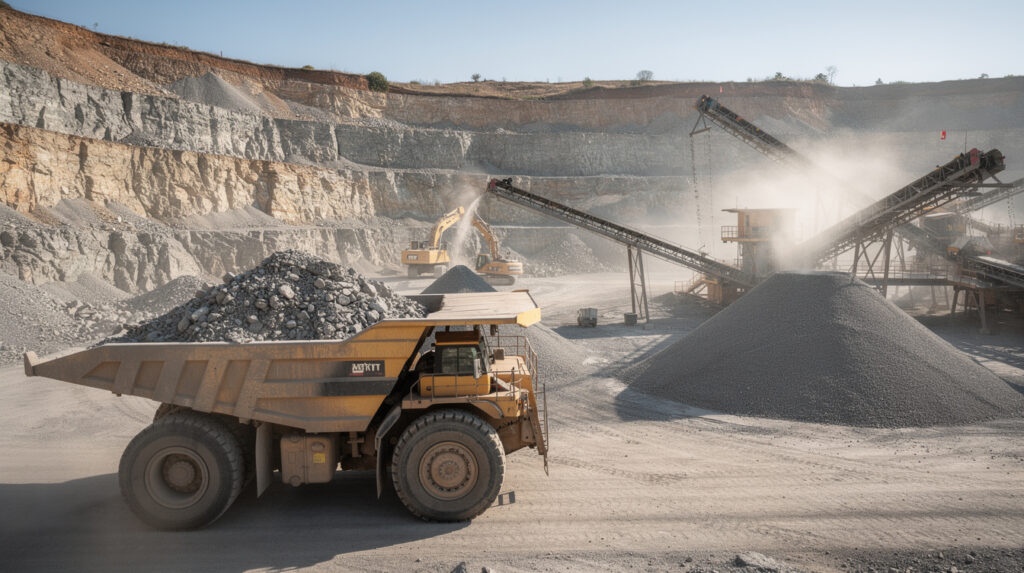
Aggregates production is the mining and crushing of stone, sand, and gravel for construction and infrastructure. It encompasses site selection, blasting, crushing, screening, and grading material to specification.
Modern plants employ conveyor systems, jaw and cone crushers, and dust control to maintain output in compliance. Energy consumption, material yield, and particle size control inform operations.
The body reviews equipment, workflows, and cost drivers.
What Are Construction Aggregates?
Construction aggregates, including sand, gravel, crushed stone, and recycled concrete, are granular materials that serve as fundamental building blocks in construction. Ranging from 20 mm down to dust, these materials form essential aggregate layers in many mixes and structures. Aggregates not only add volume and stability but also enhance load-bearing capabilities while influencing workability, strength, permeability, and durability of the finished products.
In both concrete and asphalt, aggregates are the main component. Coarse and fine aggregates together usually account for 60 to 80 volumetric percent of concrete. Coarse fractions provide structural bulk, while fine fractions, such as sand, fill voids and improve cohesion. In asphalt, graded aggregates create the framework that resists deformation under traffic loads, making them crucial for the aggregates market.
Different types of aggregates are required for various applications, such as masonry mortars, road bases, and railway ballast, to ensure optimal performance. These aggregates undergird essential infrastructure, including road subbases, bridge decks, rail beds, and building foundations, which all rely on appropriately selected aggregates to support loads and facilitate drainage.
For effective drainage solutions, aggregates are preferred due to their hydraulic conductivity, which surpasses that of most soils. This property allows water to flow freely and reduces hydrostatic pressure. Choosing the right grain size distribution and clean material is vital for ensuring long-term drain performance in systems like foundation drains and French drains.
Types of aggregates fall into three broad categories: natural, manufactured, and recycled. Natural aggregates are extracted from riverbeds, glacial deposits, or quarries and consist of sand, rounded gravel, and crushed rock. Manufactured aggregates are made by crushing hard rock or processing industrial by-products like slag from iron and steel production.
Recycled aggregates, derived from crushed concrete and masonry, can effectively replace virgin materials in many applications, thus reducing the environmental footprint when processed to meet quality standards. The grain size range plays a significant role in design and specification, with concrete sand and asphalt sand typically ranging from 4.75 mm down to 0.075 mm.
Gradation control and particle shape impact compaction, void ratio, and strength. Crush strength, abrasion resistance, and cleanliness are tested to verify suitability for use under traffic, in exposed pavements, or structural concrete. Recycled aggregates decrease vanilla mining and disposal tonnage.
Selectively processed recycled concrete can be utilized in base layers, backfill, and even in new concrete when contaminants are eliminated and grading is managed.
Core Aggregates Production Types
Aggregates are indispensable construction materials, forming the volume base of concrete, asphalt, and engineered fills. With the growth of the US aggregates market producing over 50 billion metric tons per year, understanding the different types of aggregate, including crushed rock aggregates and sand aggregates, is crucial for effective road construction and building projects.
1. Natural Materials
Natural aggregates, which derive from pits, quarries and riverbeds, include sand and natural gravel. Core Aggregates Production Types! Sand is a fine aggregate with a grain size classification that is used extensively in concrete, mortar and drainage layers. Processing at core aggregates production types starts with site surveys and geological mapping to identify deposits and determine overburden.
It then moves to excavators and conveyors. The processing commonly consists of washing to eliminate fines and easy grading to segregate sizes, with little or no crushing. These include natural materials that serve in structural layers, drainage systems, road base and rip rap for erosion control where large stones protect shorelines.
Performance hinges on particle size distribution and grading. Well-graded mixes reduce voids and improve compaction, while gap-graded materials influence interlock and permeability. Geological surveys help determine suitability by indicating composition, durability and abrasion resistance, which help predict service life in roads and foundations.
2. Manufactured Rock
Manufactured rock, or crushed rock, is derived from quarrying and mechanical processing. Primary blasting or cutting liberates blocks, which are subjected to primary, secondary, and tertiary crushing. Cone crushers perform well in secondary and tertiary stages to shape particles and generate angularity.
Screening and staged grading are required in order to produce consistent fractions. Its angularity and controlled properties mean that manufactured rock can be used for high strength concrete, asphalt, highway works, railway ballast and mechanically stabilised layers.
The increased angularity increases interlock and shear resistance but can increase water demand in concrete mixes. Grading control and quality testing guarantees meeting strength and durability specifications.
3. Recycled Minerals
Recycled aggregates are salvaged from demolition debris, such as crushed concrete and reclaimed asphalt pavement. Processing is the decontamination, crushing, screening, and sometimes washing that removes impurities and fines. Recycled materials reduce landfill space and reduce primary aggregate demand, which is a sustainability winner.
Typical uses are road base, fill, and subbase. Quality control is key. Variability in source material requires testing for residual contaminants, strength, and particle shape to meet engineering standards.
When properly processed, recycled aggregates can meet performance requirements for many non-structural and some structural applications.
4. Industrial Byproducts
Industrial byproducts are slag, fly ash, and lightweight manufacturing aggregates. These can then be converted into aggregate alternatives or incorporated into concrete mixes to increase workability, reduce weight, or provide other attributes. Byproduct utilization saves resources and decreases virgin aggregate consumption.
Tough stuff as far as variable chemistry and non-uniform particle size goes, not to mention processing to structural specs. They still require extensive testing and conditioning before they can be used on a large scale in crucial structures.
These materials are used in specialty concrete, lightweight fills, and environmental applications.
Technical Classification Standards
Technical classification standards provide the minimum bar by which to classify, test, and certify different types of aggregate for specific construction applications. These standards define grain size bands, particle shape limits, and unit weight ranges, ensuring that materials like crushed rock aggregates meet the requirements for road construction and building projects.
Grain Size
Grain size is one of the first determinations as to what an aggregate can be used for. It governs permeability, compaction, and mix stability. Standard size classes typically range from 63 mm down to 6.3 mm, with finer fractions beneath that used in sand and filler roles.
- Type 1: 63 mm to 20 mm
- 6F2: 40 mm to 2 mm
- 6F5: 31.5 mm to 2 mm
- Common sand: 6.3 mm to 0.063 mm
- Filler: < 0.063 mm
Adequate grading facilitates compaction, minimizes voids and enhances load transfer in both concrete and asphalt. A good-graded mix minimizes binder requirement in asphalt mixes, hastens compaction and decreases permeability in pavements.
Testing typically segregates samples into individual size classes to generate a grading curve that informs mix design and specification conformance. For highway contracts, you have to hit the defined grading band to provide consistent performance under traffic and environmental loads.
Particle Shape
Particle shape influences workability and mechanical response. Angular particles interlock and provide high shear strength. Rounded grains enhance workability and finishing ease.
Crushed manufactured aggregates are typically more angular, providing better interlock in bound layers like asphalt or concrete. Dense packing from angular and sub-angular grains increases stiffness and decreases permanent deformation in road layers.
Flaky and elongated particles may form weak planes, reducing compacted density and load-bearing capacity. Standards identify any grain whose largest dimension-to-thinnest dimension ratio exceeds 3 as defective.
Surface geometry affects texture and skid resistance: rough, angular faces increase macrotexture and friction, while smooth rounded particles reduce skid performance.
Unit Weight
Unit weight, or bulk density, is mass per volume and is core to mix quantity computations and structural evaluation. General classification according to specific gravity classifies aggregates as lightweight (less than or equal to 2400 kg/m³), normal-weight (2400 to 2800 kg/m³), and heavy (greater than or equal to 2800 kg/m³).
Natural gravel, crushed rock and lightweight aggregates have different bulk densities. Crushed rock typically rests around 2600 kg/m³. Natural gravel may be different but can fall into normal-weight ranges.
Lightweight aggregates can be much lower depending on porosity. Density differences vary structural capacity per volume and affect shipping and handling expenses. Lower density leads to bigger volumes for the same mass.
Contract notes and standards like TS EN 13242 + A1 and TS 706 EN 12620 + A1 help direct permissible ranges and testing to maintain projects uniform and secure.
Quality Control Metrics
Quality control metrics establish the foundation for trustworthy aggregates in concrete output. They detail what to test, how frequently, and what the acceptable limits are for materials to comply with BS EN 12620, BS EN 13242, and BS EN 13043. Metrics link lab findings to field performance, and independent third-party verifications frequently support them to minimize risk and keep projects on schedule and on budget in the construction industry.
Mechanical Strength
Compressive and shear strength rate how aggregates perform under load and sliding forces. Compressive strength responds to crushing and shear strength to internal sliding under tangential stress. Both are vital where aggregates constitute the load path in concrete and asphalt.
Do’s and Don’ts for testing aggregate strength:
- Yes, conduct crushed and L.A. abrasion tests per standards.
- Sample across production runs, not once per source.
- Do correlate lab strength with field performance data.
- For instance, don’t depend on one experiment. Employ several force measures.
- Don’t test only fine fractions; coarse particle integrity matters.
- Don’t skip sample conditioning to a consistent moisture state.
Mineral composition of quartz and feldspar, flaky or elongated particles, and particle integrity all have a direct impact on strength. High-strength aggregates are needed for highways, bridges, and railroads, where cyclical heavy loading and factor of safety considerations necessitate stringent strength ranges.
Water Absorption
Water absorption measures porosity and forecasts durability problems. It essentially measures how much water an aggregate will absorb under normal situations, which connects freeze-thaw risk and long-term strength loss.
High absorption increases concrete mix water demand, which in turn necessitates either increasing water-cement ratios or using more admixtures, both damaging to durability and workability. In freeze-thaw zones, absorbed water expands on freezing and causes microcracking that leads to scaling.
Contrast absorption rates of sources, such as recycled aggregates that generally demonstrate greater absorption than natural rock. Lab comparisons need to be on the same conditioning and particle size ranges to be valuable.
Low-absorption aggregates are necessary for exposed or structural applications where ingress and cyclic freeze-thaw are issues. State upper absorption rates in purchasing documents.
Chemical Stability
Chemical stability refers to its resistance to adverse reactions with cement, water, and environmental agents. Weak aggregates will result in expansion, staining, or a loss of strength.
Key tests for chemical risks:
- Tested for sulfate content to avoid sulfate attack on cementitious binders.
- Chloride testing to avoid steel corrosion in reinforced concrete.
- Reactive silica testing is important to avoid expansive alkali-silica reaction damage.
- pH and soluble salt checks for site-specific exposure assessments.
Testing for sulfates, chlorides, and reactive silica is important since each can cause certain failure modes that reduce service life and increase maintenance requirements. Early detection is key to long-term infrastructure performance, and bad chemical stability drives up life-cycle costs and inspection frequency.
Primary Structural Applications
Primary structural applications utilize aggregates as a fundamental building block in concrete, asphalt, and engineered fills, where they typically comprise 60% to 80% of the total material by weight. Aggregates have diverse sources, including natural ones such as marine and superficial deposits, manufactured, and recycled. They develop through erosion, weathering, and chemical or biological activity that reduces parent rock to usable sizes.
As noted, your primary concern with aggregate selection should be your application: durability, workability, and long-term performance in bridges, roads, foundations, housing, and more.
Aggregate types matched to structural uses
|
Aggregate type |
Typical structural use |
Notes on size and performance |
|---|---|---|
|
Limestone (natural) |
Reinforced concrete, blockwork, precast |
Common, good shape; 20 mm coarse often used in reinforced concrete |
|
Sandstone (natural) |
Masonry, bedding, concrete |
Variable strength; suitable where abrasion is moderate |
|
Igneous rock (crushed granite) |
Heavy-duty concrete, pavements, marine works |
High strength and angular shape; 40 mm used for mass concrete |
|
Manufactured (e.g., slag, crushed recycled concrete) |
Sub-base, lightweight concrete, fill |
Controlled grading; recycled concrete used in lower-risk structural fills |
|
Marine and superficial deposits (rounded sand/gravel) |
Asphalt, concrete with careful mix design |
Rounded grains improve workability but reduce interlock |
|
Type 1 (UK spec) |
Road bases, sub-base for trafficked areas |
Well-graded granular sub-base with good compaction |
|
Type 2 (UK spec) |
Domestic/commercial sub-base, pothole repair, backfill |
Versatile sub-base material; used for general fills and repairs |
|
Type 6F2 / 6F5 (UK specs) |
Recycled sub-base and fill with fine content |
Recycled, engineered for stable sub-bases and capping layers |
How selection varies by application: size, shape, strength
Choice is a function of loading, exposure, and construction technique. Flexural reinforced concrete requires coarse aggregate in the region of 20 mm, which provides good packing and ease of placement. For mass concrete where thermal control is key, larger 40 mm aggregates cut cement demand and heat of hydration.
Angular, crushed particles provide superior mechanical interlock and greater strength but impede flow. Coarse marine or surface sands enhance flow and finish but might require additional cement to achieve strength goals. The strength of the parent rock is igneous for high strength and limestone or sandstone for routine structural elements. This also counts for durability and resistance to freeze-thaw or chemical attack.
Role in infrastructure expansion and housing
Aggregates support public infrastructure expansion and residential development by providing base materials for highways, rail ballast, footings, and structural concrete. Type 1 and Type 2 are trusted sub-bases for new roads and housing estates, with recycled 6F2 and 6F5 meeting sustainability targets and reducing landfill.
Appropriate species selection and grading reduce lifecycle costs, construction time, and maintenance.
Modern Industry Transformations
The aggregates industry has been racing forward in the last ten years, fueled by technology, regulation, and major public projects. The growth of the US aggregates market has driven plants to mix mechanical upgrades with digital systems to satisfy the demand for different types of aggregate from infrastructure and urban growth globally. This evolution changes how we think about efficiency, emissions, supply chains, and environmental permitting.
Digital Automation
Automated plant operations now control crushing, screening, and stockpiles with less hands-on involvement. Modern processing lines employ conveyors to transport concrete aggregate between jaw crushers, cone crushers, and screens, slashing handoffs and downtime. Central control rooms operate PLCs and SCADA to modify feed rates, crusher gaps, and screen settings in near real-time, ensuring efficiency in the aggregates market.
Digital tools save fuel and boost productivity in the construction industry. Fleet telematics cut haul truck and loader idle time, while route optimization of deliveries reduces kilometers driven and diesel burn. Inventory management systems integrate site stockpiles with sales platforms so sales teams can commit loads based on quantified reserve volumes of different types of aggregate instead of approximations.
Real-time data is crucial when it comes to aggregate reserves and capacity. Lidar, drone surveys, and fixed sensors back GIS databases to visualize current tonnage in pits and stockpiles and project mine life more accurately. This information assists in knowing when to open new pits or stop extraction to observe ecological restraints and maintain sustainability in resource management.
Geospatial analytics connect resource planning to logistics effectively. Heat maps of demand, layers of transport costs, and traffic models assist planners in locating small, urbanized terminals where they are needed. For instance, satellites identify virgin material patches and subsequently design conveyor or truck routes that minimize disruption in dense areas, enhancing the efficiency of the supply chain.
Carbon Capture
Carbon capture during aggregates production spans emissions and material design. At the plant level, capture systems can trap CO2 from fuel combustion or cement-related processes used in concrete batching near quarries. Captured CO2 is stored temporarily or in mineralization steps, enhancing the supply chain of aggregate materials.
Recycled materials and industrial byproducts reduce life-cycle emissions. Adding blast-furnace slag, fly ash, or recycled concrete aggregates directly decreases consumption of virgin quarried rock and the embodied carbon of final mixes. These inputs typically require different crushing and screening configurations but are within the scope of modern automated plants that handle various types of aggregate.
Other advances lock CO2 into concrete and asphalt mixtures containing aggregates. CO2cure’s accelerated carbonation methods and CO2-cured aggregate products lock carbon in stable mineral phases, making pavements and precast units net carbon emissions reducers. Pilot projects demonstrate carbon intensity reductions per cubic meter, contributing to the sustainability of the construction industry.
Sustainability has become imperative for longevity and for regulatory adherence. Regulators eye tighter permitting and emissions limits, so capture investments, recycled inputs, and energy-efficient equipment are risk management and market differentiation.
Because of the industry’s sizable economic footprint—somewhere in the neighborhood of $28.9 billion—these shifts spread far and wide throughout construction and transport sectors.
Conclusion
Aggregates fuel the constructed world. They create road beds, concrete mixtures, drainage layers and rail ballast. Producers save money by optimizing feed size, crusher configurations, and wash plant flow. Labs test gradation, strength, and purity. Field crews match specs to use: higher strength for slabs and coarser mixes for drainage. New tech adds remote sensors, real-time screens, and data dashboards that catch problems fast and keep plants idle-free. Environmental regulations are driving improved dust suppression, water recycling, and site restoration. Small process changes deliver huge product life and project cost gains. Read plant data, set clean specs, and test often. Give a site audit or a materials trial a shot on your next project and watch what a difference it makes!
Frequently Asked Questions
What are construction aggregates?
Construction aggregates, including crushed rock aggregates and sand aggregates, consist of crushed stone, gravel, and crushed recycled concrete. They are essential for concrete aggregate, asphalt, and road construction, providing bulk, strength, and stability.
How are aggregates produced?
Aggregates, including crushed rock aggregates and recycled concrete, are produced by quarrying rock, crushing it to various sizes, and washing for different types of aggregate applications.
What standards classify aggregate quality?
We meet all ASTM, EN, and local codes, which specify sizing, grading, and strength for different types of aggregate to ensure secure and predictable performance.
What tests measure aggregate quality?
Typical tests include sieve analysis, LA abrasion, and water absorption, which assess different types of aggregate for their strength and suitability in concrete aggregate applications.
Where are aggregates mainly used?
Aggregates, including different types of aggregate like crushed rock aggregates and sand aggregates, are essential in concrete, asphalt, and road construction.
How does aggregate choice affect structural performance?
The particle size and grading of different types of aggregate significantly affect concrete strength and workability, enhancing long-term performance.
What modern trends affect aggregate production?
Trends to watch in the aggregates market include recycled materials, automated crushing plants, and different types of aggregate processing, along with real-time quality monitoring of sand and aggregates for lower carbon footprints.